

Blog
Insights
Beyond Glass: What the Bulk and Private Label Trade Needs to Know About Alternative Packaging Now

Packamama's founder on proof, price parity, and what's coming next.
For buyers, importers, and private label decision-makers, packaging is not an environmental question first — it is a commercial one. Does it protect the wine? Does it move off shelf? Does it hold margin? Does it scale?
Santiago Navarro, CEO and founder of Packamama, has spent years building the evidence base to answer those questions for alternative wine formats. His company has now traded across enough retailers, geographies, and supply chains to speak with data rather than theory.
With EPR costs rising, deposit return schemes accelerating, and retailer sustainability targets becoming a harder commercial reality, the conversation around format is shifting. We asked Navarro where the trade actually stands — on adoption, economics, buyer resistance, and what comes next.
1. The real barrier.
Glass still dominates despite cost and carbon pressure. What’s the biggest blocker to change today: perception, economics, or supply chain risk?
The biggest blocker is the human relationship with change.
Humans are hardwired not to like change because change brings risk, and risk has not historically been good for survival. In any market, including wine, most people are more comfortable with what they know. It is normally the outliers in the tribe who innovate: the people who see that calculated risk can bring opportunity, not inevitable downside.
So yes, perception, economics, and supply chain risk all matter, but they sit underneath a bigger issue: fear of the unknown. The way to overcome that is data.
At Packamama, we think about this through three pillars: planet protection, wine protection, and commercial protection. Planet protection is about lower emissions, recyclability, end-of-life, and circularity. Wine protection is about keeping oxygen out, retaining CO₂ where needed, and using materials that are inert and non-reactive with wine. Commercial protection is about whether the product sells, whether people repeat purchase, whether it creates engagement, whether it protects margin, and whether it can scale.
A useful comparison outside wine is electric vehicles. Many people still worry about range anxiety, even though petrol cars and electric cars both have a gauge telling you how much fuel or charge is left. In both cases, you simply need to plan your journey. But the new technology feels riskier because it is less familiar. Wine packaging has a similar challenge. Glass feels safe because it is familiar, even when the data increasingly shows that other formats may be better suited to many wines, occasions, and supply chains.
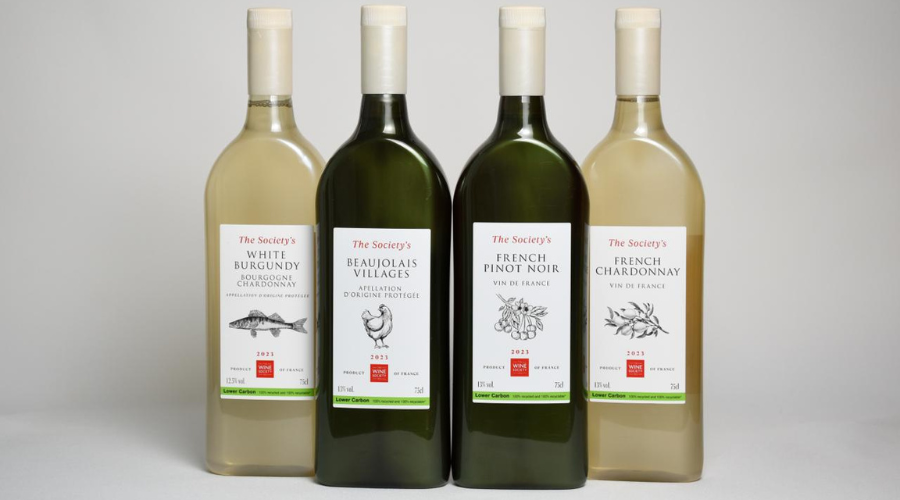
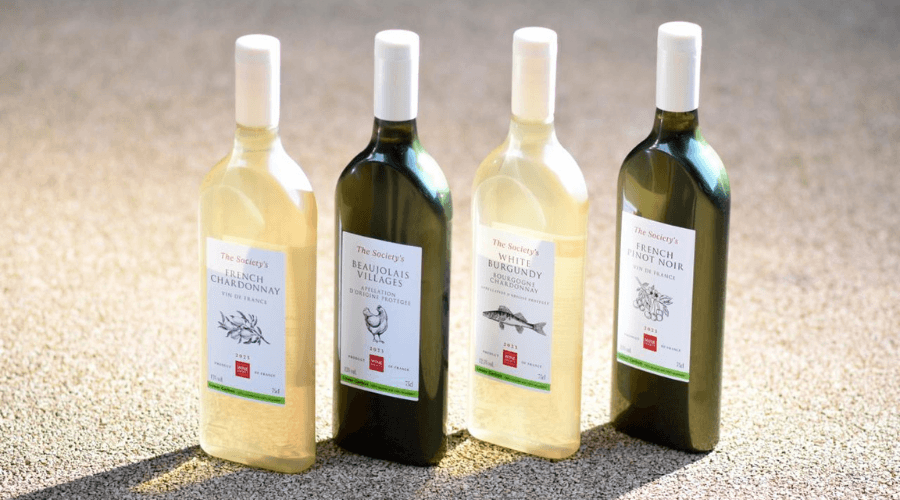
Image: The Wine Society's Beaujolais-Villages and French Pinot Noir in eco-flat bottles.
We are now reaching the point where the risk of inaction is greater than the risk of calculated action. That is an important shift. For years, the perceived risk sat with the innovator: what if consumers do not accept it, what if the wine does not perform, what if the economics do not work? But Packamama has now been in the market long enough, across enough retailers, producers and geographies, to build real evidence around consumer acceptance, wine protection, emissions reduction, and commercial performance. At the same time, the external pressures are increasing: EPR costs, deposit return schemes, retailer emissions targets, supply chain pressure, and the reality of a heating planet. So the question is no longer simply, “What is the risk of moving?” It is also, “What is the risk of not moving?”
That does not mean the industry should take irrational risks. It should not. No sensible producer should move an entire portfolio out of glass overnight. The right approach is to test, measure, learn, and then scale. But the balance of risk has changed. In difficult market conditions, calculated innovation is not more dangerous; it is often more necessary.
2. Where adoption is actually happening.
Where are you seeing the fastest real adoption right now, and in which segments: premium, everyday, private label?
The fastest real adoption is happening in everyday wines and private label. That is where the logic is strongest because these are the segments where volume, logistics, cost, emissions, and retail performance matter most.
Premium wine is more traditional, and that is understandable. Fine wine is often tied to heritage, ritual, provenance, and the idea of wine in its “authentic” state. That part of the market has an oversized value per unit and an important cultural role, but it is a small part of total wine volume.
The bigger opportunity is in the everyday drinking occasions where most wine is consumed. That is also where the carbon and logistics impact of heavy glass is most significant. If the wine is designed to be consumed within a reasonable timeframe, and if the packaging protects the wine properly, there is a very strong case for asking whether traditional heavy glass is really the best format.
Private label is especially important because retailers have both the data and the incentive to look at total system performance: rate of sale, supply chain efficiency, emissions, shelf impact, customer acceptance, and margin.
3. Proof over claims.
What measurable impact does your packaging deliver versus glass, in terms that matter to buyers and retailers?
We measure impact across three areas: planet, wine, and commercial performance.
On the planet side, our formats can deliver around 50% lower emissions than comparable glass alternatives, depending on the supply chain and comparison point. They are also designed to be recyclable at the end of life. PET and aluminium are particularly relevant because they are among the formats most naturally suited to deposit return schemes, where there is a more controlled recycling environment.
On wine protection, PET is inert to wine, so the material does not react with the liquid. The technical challenge compared with glass is gas permeability, which is why we use advanced barrier technologies as part of our proprietary material stack to improve performance. Our work is about keeping oxygen out, retaining CO₂ where needed, and continuing to build the data that tells us which material stack is right for which type of wine.
On the commercial side, buyers and retailers need to know whether the product actually works in the market. Does it sell? Does it get repeated purchases? Does it generate attention? Does it protect the margin? Does it create a reason for the shopper to engage? So, we look at the rate of sale, repeat purchase, social media engagement, customer feedback, media interest, and price competitiveness.
Sustainability claims alone are not enough. A packaging format has to protect the planet, protect the wine, and protect the commercial interests of the producer or retailer.
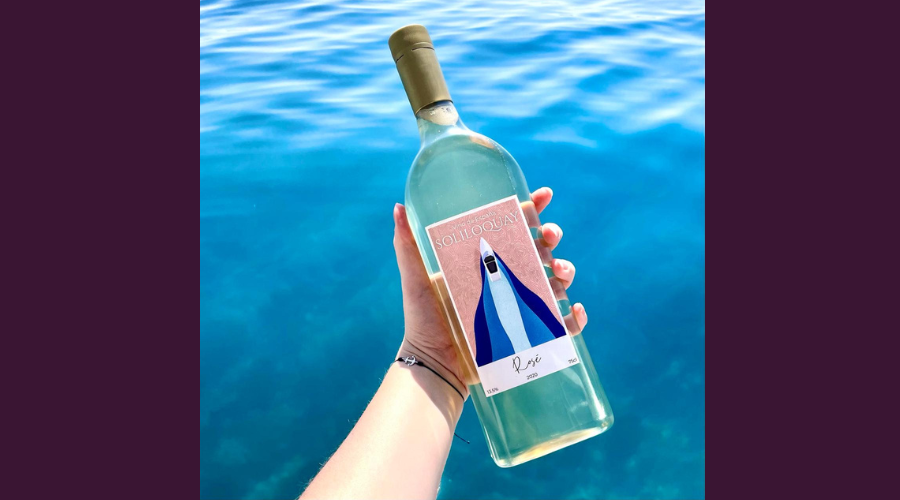
Image: Packamama's eco-flat bottles.
4. Commercial tipping point.
At what scale does your format become cost-competitive with glass, and are you there yet?
We are not fully there yet, but we are close, and we know what needs to happen.
Our view is that the format becomes meaningfully cost-competitive with glass when we are shipping roughly 10 to 20 million units from a single site. At that level, the production and supply chain efficiencies start to work properly.
Price parity matters enormously. It is not enough to say a format is lower carbon or more convenient if it permanently squeezes the margin of the producer or the retailer. That is not a sustainable model. We want to make sustainable wine packaging commercially sensible, not just environmentally attractive.
We are working on arrangements that are not yet ready to be disclosed, but the objective is clear: to reach price parity with glass in the markets where we operate. That is critical if this is going to move from innovation to mainstream adoption.
5. Buyer resistance.
What are the top objections you still hear from distributors or retailers before they commit?
The objections are usually expressions of risk.
Will consumers accept it? Will the wine be protected? Will it sell? Will it be repeat purchased? Will the supply chain cope? Will it be cost-competitive? Will the retailer or distributor be exposed if the market does not respond?
These are reasonable questions. The answer is not to dismiss them. The answer is to provide data.
That is why we focus so heavily on planet protection, wine protection, and commercial protection. If we can show lower emissions, recyclability, strong wine performance, good rates of sale, repeat purchase, and credible economics, then the perceived risk becomes much smaller.
Increasingly, buyer resistance also needs to be weighed against the risk of doing nothing. With EPR, deposit return schemes, retailer emissions targets, supply chain pressure, and climate pressure all moving in the same direction, maintaining the status quo is not a neutral decision. It is also a risk. The industry should not act recklessly, but it should recognise that the balance has changed: calculated action is becoming less risky than continued inaction.
It is also worth saying that if everyone is immediately comfortable with what you are doing, it probably is not very innovative. Real innovation normally makes some people uncomfortable at first. You do not need everyone to say yes at the beginning. You need the right early adopters: people who understand calculated risk, can evaluate data, and are willing to test something that could create an advantage.
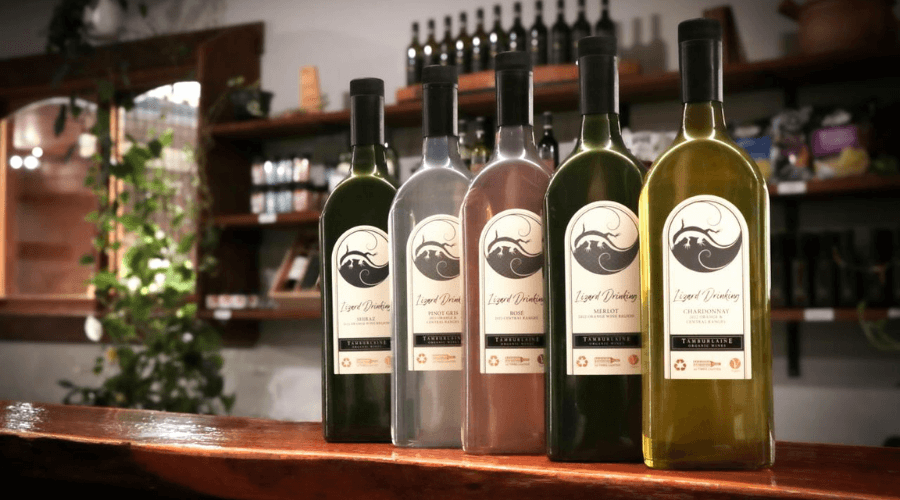
Image: Packamama's eco-flat bottles are reshaping perceptions of what modern wine packaging can achieve.
6. Consumer reality check.
What’s the biggest misconception consumers still have about non-glass wine packaging?
The biggest misconception is that non-glass automatically means lower quality.
That is not surprising, because glass has been the dominant signal of wine quality for a very long time. But the packaging material and the quality of the wine are not the same thing. A good wine in a well-engineered, lower-carbon format is still a good wine.
A lot of consumer resistance is really just resistance to change. People see something unfamiliar and ask, “Why is this different?” That happens across many technologies. You can see it with electric vehicles, self-driving taxis, or almost any new system that challenges an old habit. The first reaction is often emotional before it is rational.
But wine also has an important trust layer: the retailer. If a shopper sees a new format in a retailer they know and trust, many will assume – correctly – that the buyer has done due diligence. Retailers like Tesco or Aldi UK do not put products on shelf casually. Their buying and quality processes create confidence for the consumer.
We are not trying to say every wine should be in our format, or that every consumer needs to change overnight. The point is that the wine industry is still overwhelmingly packed in glass, and that cannot be the right answer for every wine, every price point, every occasion, and every supply chain.
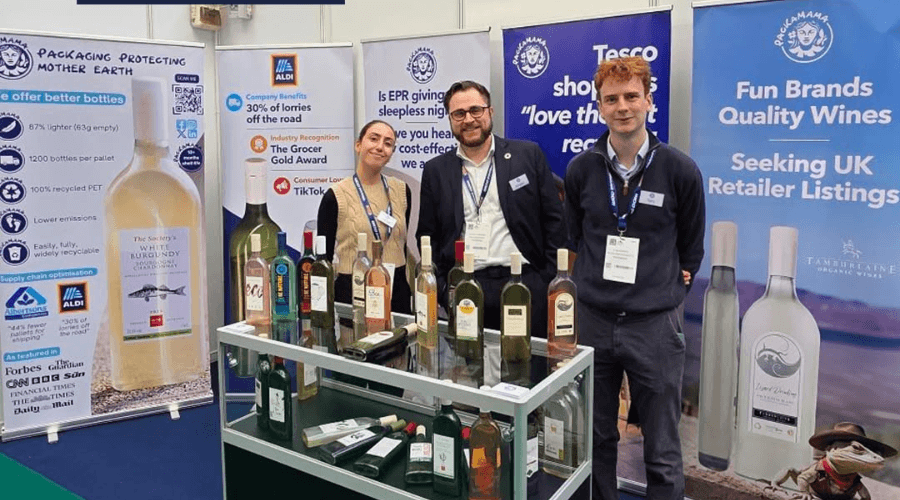
Image: The Packamama team at London Wine Fair 2025.
7. What’s new.
What should the trade be paying attention to from Packamama this year?
The trade should pay attention to Packamama moving beyond what we have been best known for.
We are known for flat-pack bottles and 75cl formats, but the opportunity is broader than that. Without disclosing too much before we are ready, I would say: beyond flat and beyond 75cl.
There are new things coming online that are exciting because they show this is not just about one clever bottle shape. The bigger story is about building a more complete packaging and manufacturing system for lower-carbon wine.
The wine industry needs more format choice. Different wines, different occasions, different channels, and different supply chains will need different packaging solutions. That is where we see the future.
8. Practical takeaway.
If a mid-sized wine brand is considering switching today, what’s the first step they should take?
The first step is to run a well-designed trial.
Do not switch the whole portfolio. That would be the wrong advice. No sensible business should take an all-in risk on a new packaging format. The right approach is phased and evidence-led.
A mid-sized wine brand should choose a specific product, a specific channel, and a specific consumer occasion. The trial could happen through a trusted retailer, where the retailer’s own quality and buying process gives shoppers confidence. Or it could happen through direct-to-consumer channels, where the brand can speak directly to customers, explain the benefits, and gather feedback.
The important thing is to measure properly: sales, repeat purchase, consumer response, emissions, logistics, margin, and occasion fit.
We have seen the value of this approach with partners such as The Wine Society and Tamburlaine in Australia, where direct customer or member engagement helps build understanding and feedback. We have also seen the value of retail channels, where till data and retailer trust can show whether the format works in a more mainstream environment.
The wine industry is more than 30 billion units globally and remains overwhelmingly packed in glass. That does not feel like a balanced or rational packaging mix for such a diverse global category. So the first step is not a dramatic leap. It is a focused trial that generates the evidence needed to move with confidence.
Conclusion:
Navarro is not asking the trade to abandon glass. He is asking it to stop treating the question as settled. The evidence on consumer acceptance, wine protection, and commercial performance has moved further than many buyers realise. The external pressures — legislative, logistical, environmental — are not easing.
For any brand or retailer carrying significant private label or everyday volume, the framework he outlines is worth taking seriously: choose a product, choose a channel, measure properly, and see what the data says. That is not a disruption. That is due diligence.
Header Image: From left to right: Angelo Marangi, Krista Mellupe, Santiago Navarro, and Richard Lloyd.
Also Read:
Building Wine Brands in the UK: An Interview with Robin Copestick
Get Your Visitor Tickets Here and join the bulk and private label industry in London on March 25-26, 2027. (Trade is free)